
Coffee County Property Tax Information and Assessment Records
Coffee County sits in south Georgia. Douglas serves as the county seat. The Tax Assessor maintains property records here. Thousands of parcels exist in the county. Property owners rely on these records. Values are set each year. The assessment process follows state law. Records are open to the public. Owners can search online with ease. QPublic.net hosts the database for Coffee County. This guide covers how to access records. You will learn about appeals too. Exemptions can lower your bill each year. Payment options are explained below. Douglas remains the hub for all tax work in the county. The office serves residents with care.
Coffee County Tax Facts
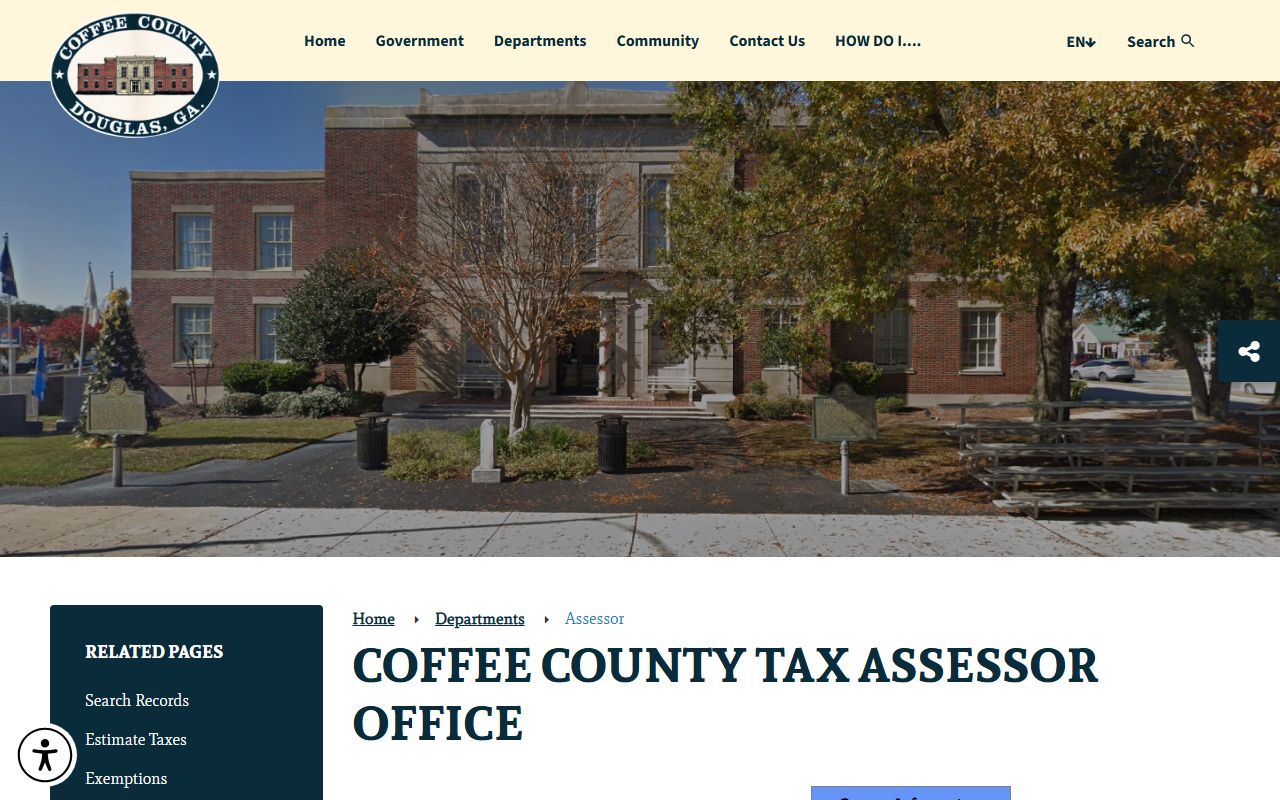
Coffee County Tax Assessor Office
The Tax Assessor values all property in Coffee County. The office is in Douglas. Staff work to ensure fair assessments. Georgia law guides their work. Values must reflect market conditions. The office reviews sales data. They inspect properties when needed. Records are updated each year.
Tracy S. Cason serves as Chief Appraiser. The staff reports to the Board of Tax Assessors. This board sets policy for assessments. They hire the Chief Appraiser. The board meets each month. Meetings are open to the public. Minutes are posted online. Check the county website for dates.
| Tax Assessor Office |
101 South Peterson Avenue Douglas, GA 31533 |
|---|---|
| Phone | 912-389-4405 |
| Fax | 912-389-4408 |
| tcasson@coffeecounty.us | |
| Office Hours | Monday - Friday, 8:00 a.m. - 5:00 p.m. |
| Online Records | qpublic.net/ga/coffee |
The office handles all property assessments. They also process exemption applications. New construction is reviewed. Property splits are recorded. The staff answers questions by phone. Walk-in visits are welcome. Call ahead for complex issues.
How to Search Coffee County Property Tax Records
Coffee County uses QPublic.net for online records. This system is free to use. You can search anytime. The database is updated regularly. Results show current values. Ownership history appears too. Sales data is included.
To start your search, visit the website. Enter the address you seek. Owner names work well. Parcel numbers give exact matches. Try different spellings if needed. The system searches all fields. Results appear in seconds. You can print or save them.
The online system shows key details. Property values are displayed. Land and building values are split. Acreage is listed. Structure details appear. Year built is shown. Square footage is included. The site shows tax district info too.
Maps are available online. You can view property boundaries. Aerial photos help you locate land. Neighboring parcels are shown. This helps with comparisons. Sales in the area appear. This data helps with value questions.
In-person searches are also offered. Visit the office in Douglas. Staff can assist you. Bring property details with you. Office hours are listed above. Allow time for your visit. Some records may take time to find. The staff works to help all visitors.
The Georgia Department of Revenue provides helpful facts. Their site covers all counties. Millage rates are listed. Exemption rules appear there. Contact details are provided. Visit their site for state tax info. The link is in our resources section.
Understanding Property Assessments in Coffee County
Assessments value property for tax purposes. Coffee County values real estate each year. The goal is fair and uniform values. Georgia law sets the rules. The state requires assessments at 40% of market value. This is the assessed value. Taxes are based on this amount.
Assessors review sales data. Recent sales guide values. Location affects price. Size matters too. Condition is reviewed. Improvements add value. Land value is separate. All factors are weighed.
Assessment notices go out in spring. They show your new value. The notice includes an estimate. This shows what taxes might be. The final amount depends on millage rates. These rates are set later. County and city budgets determine rates. Schools set their rates too.
You can appeal your assessment. You must act fast. The deadline is 45 days. The date is on your notice. File your appeal in writing. State your reason clearly. Value disputes are valid grounds. Uniformity issues can be raised. Taxability questions are allowed. Denial of exemptions may be appealed.
The appeal process has steps. First, file with the Assessors office. They may offer to settle. A review may change the value. If you disagree, you can go further. The next step is a hearing. The Board of Equalization hears cases. This board is separate from the Assessors. They make fair decisions.
Appeals require good evidence. Recent sales help your case. Similar properties should be compared. Photos may be useful. Appraisals carry weight. The board reviews all facts. Come prepared to present your case. Be clear and brief. Respect the process.
Paying Property Taxes in Coffee County
Tax bills arrive each fall. The Tax Commissioner sends them out. Bills are due within 60 days. The due date is on the bill. Pay on time to avoid fees. Interest accrues on late payments. Penalties may be added too.
Coffee County offers payment options. You can pay by mail. Send a check to the office. Include your parcel number. Write it on the check. Allow time for delivery. Postmark date matters. Payments must be postmarked by the due date.
In-person payments are accepted. Visit the Tax Commissioner office. Cash is welcome. Checks are accepted. Cards may be used. Ask about fees for card use. The office is in the courthouse. Hours are Monday through Friday.
Online payment may be available. Check the county website. Some counties use third-party sites. Fees often apply for this service. Have your parcel number ready. You will need it to search. The system guides you through payment. Print your receipt for records.
Tax bills reflect January 1 ownership. This is the legal date. Changes later in the year do not matter. Buyers and sellers must agree on taxes. This happens at closing. The Tax Commissioner does not handle this. Check your closing papers. Make sure taxes are addressed.
Delinquent taxes cause problems. The county can place liens. Property may be sold eventually. Do not ignore tax bills. Contact the office if you need help. Payment plans may be offered. Ask about your options. Stay current on your taxes.
Property Tax Exemptions in Coffee County
Exemptions lower your tax bill. They reduce the taxable value. Some exemptions are total. Others remove part of the value. You must apply to get them. The Tax Assessor handles applications. Deadlines are strict. Do not miss them.
The homestead exemption is common. It applies to primary homes. You must live there. The home must be your legal residence. You can only have one homestead. Application is required the first year. The deadline is April 1. This date never changes.
Homestead exemptions renew each year. You do not need to reapply. The exemption stays with the property. New owners must apply. Changes to your deed matter. Refinancing usually does not. Check with the office if unsure. They can explain the rules.
Senior citizens may get extra relief. Age 65 brings new options. Income limits may apply. Check the current rules. Veterans can get exemptions too. Service-connected disability qualifies. The amount depends on the rating. Surviving spouses may be eligible. Each case is reviewed.
Disabled homeowners have options too. Some disabilities qualify for relief. Documentation is required. The office can explain what is needed. Apply by the April 1 deadline. Late applications are not accepted. Wait until the next year if you miss it.
Other exemptions exist. Some are for special cases. Conservation use is one. Forest land may qualify. Agricultural use has rules. Contact the office for details. Each program has forms. Staff will guide you through the process.
Georgia State Tax Resources
The state offers helpful resources. The Department of Revenue oversees property taxes. They publish guides for taxpayers. County facts are listed online. These resources explain the law. They cover taxpayer rights too.
Georgia law protects property owners. You have the right to fair treatment. Assessments must be uniform. Appeals are your right. You can question your value. The process is open and fair. Learn about your rights. The state website explains them.
Millage rates vary by location. The state tracks these rates. County rates are listed. City rates appear too. School rates are separate. All rates combine for your bill. Check the state site for data. It covers all Georgia counties.
Nearby Counties and Resources
Coffee County borders several other counties. Each has its own tax offices. Records are kept separately. You must search each county. Neighboring counties include Atkinson to the south. Bacon County sits to the northeast. Jeff Davis County is to the east. Ware County lies to the southeast.
Douglas is the main city in Coffee County. It serves as the county seat. Most county offices are there. The Tax Assessor is in Douglas. The Tax Commissioner is there too. Court functions happen in Douglas. It is the center of county government.
Nicholls is another city in the county. It sits in the southern part. Residents there pay county taxes. City taxes may apply too. Broxton is also in Coffee County. It is in the northern area. Each area has the same county tax rate. City rates vary by location.
Property owners near county lines should check boundaries. Your tax office depends on location. Coffee County records are in Douglas. Do not confuse this with Douglas County. That is a different county near Atlanta. Coffee County is in south Georgia. Always verify your county.
Additional Resources
These websites offer more information about Coffee County property taxes. Visit them for forms and online records. State tax data is available too.
Coffee County QPublic.net - Online property records and assessments
Georgia Department of Revenue County Tax Facts - State tax information and millage rates
Georgia Taxpayers Bill of Rights - Your rights as a property owner