
Lamar County Property Tax Assessment Search and Records
Lamar County property tax records are public documents maintained by the county government. These records contain assessed values for all real and personal property located within the county boundaries. The county seat is Barnesville, which serves as the administrative center for tax assessments and collections. Lamar County uses QPublic.net as its online property search platform, providing residents with convenient access to assessment data, parcel maps, and property details from any internet-connected device.
Lamar County Property Tax Quick Facts
Lamar County Property Search Options
Lamar County offers property owners and researchers multiple ways to access tax records. The primary method is through the QPublic.net online database, which serves many Georgia counties. This system allows you to search by owner name, street address, parcel number, or real key. The online platform is available 24 hours a day and provides instant access to current assessment data without requiring registration or payment.
The QPublic.net system for Lamar County contains comprehensive property information. You can view the current assessed value, property classification, acreage, and building details. The system also displays sales history, showing previous transactions and prices paid for the property. This information helps property owners understand how their assessment compares to recent sales in the area. Visit qpublic.net/ga/lamar to begin your search.
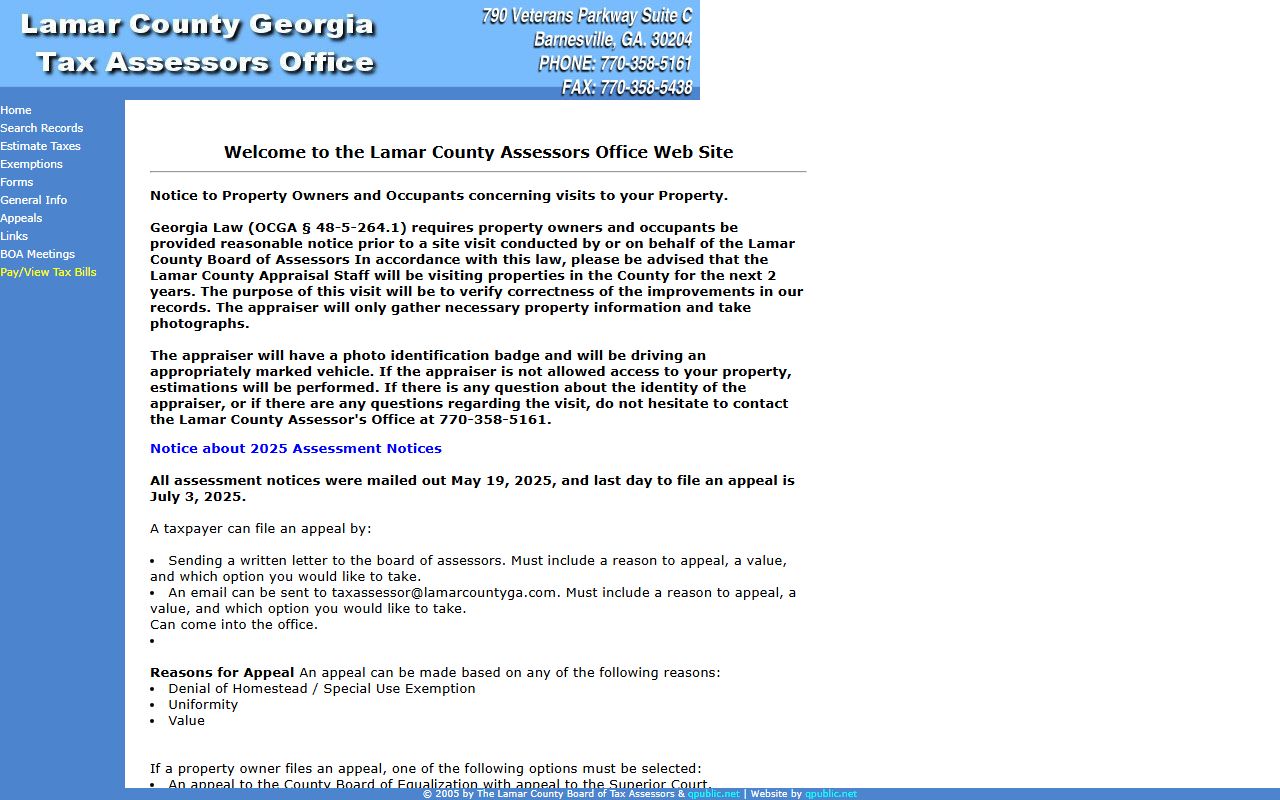
For those who prefer in-person assistance, the Lamar County Tax Assessor's Office is located in Barnesville at the courthouse. Staff members can help you locate records and explain assessment procedures. The office maintains physical files for all properties in the county. While most information is available online, some historical records or complex inquiries may require a visit to the courthouse.
The Georgia Department of Revenue provides helpful resources for understanding county property tax systems. Their website offers fact sheets for each county, including Lamar County. You can find information about assessment ratios, appeal procedures, and exemption programs at dor.georgia.gov/county-property-tax-facts. This official state resource helps property owners understand their rights and responsibilities under Georgia tax law.
Lamar County Tax Assessor Office Information
The Lamar County Board of Tax Assessors is responsible for determining the fair market value of all taxable property within the county. This constitutional office operates under Georgia law, which requires annual assessments at 40 percent of fair market value. The chief appraiser leads a team of professional assessors who review property characteristics, analyze sales data, and apply standardized valuation methods to ensure equitable assessments across the county.
The assessment process in Lamar County begins with property inspections and data collection. Staff members gather information about land characteristics, building size, construction quality, and special features. This data is entered into the computer-assisted mass appraisal system. Each year, the assessor's office reviews sales of comparable properties to ensure assessments reflect current market conditions in Barnesville and surrounding communities.
| Office Location |
Lamar County Tax Assessor 326 Thomaston Street Barnesville, GA 30204 |
|---|---|
| Mailing Address |
P.O. Box 747 Barnesville, GA 30204 |
| Phone | (770) 358-5161 |
| Fax | (770) 358-0296 |
| Hours | Monday - Friday, 8:00 a.m. - 5:00 p.m. |
| Online Search | qpublic.net/ga/lamar |
The Tax Assessor's Office mails assessment notices to property owners each spring. These notices indicate the proposed value for the upcoming tax year. It is important to review this notice carefully, as it forms the basis for your property tax bill. The notice includes instructions for filing an appeal if you believe the assessed value does not reflect fair market value.
Property record cards are available for public inspection at the assessor's office. These cards contain detailed information about each parcel, including land dimensions, building sketches, and feature descriptions. You can review your own property card or examine records for other properties in Lamar County. This transparency ensures the assessment process remains open and accountable to taxpayers.
Lamar County Tax Commissioner Information
The Lamar County Tax Commissioner is an elected constitutional officer responsible for billing and collecting property taxes. While the Tax Assessor determines property values, the Tax Commissioner calculates the actual tax amount based on these values and the millage rates set by local government entities. The commissioner's office sends tax bills, processes payments, and handles collections for all property taxes in Lamar County.
Property tax bills in Lamar County are typically mailed in the fall, with payments due by mid-December. The exact due date varies by year, so taxpayers should check their bill for the specific deadline. Taxes may be paid in full or in two installments for certain property types. The Tax Commissioner's Office accepts payments by mail, in person, or online through authorized payment processors.
If property taxes are not paid by the due date, interest and penalties begin to accrue. The Tax Commissioner's Office is responsible for collecting delinquent taxes and may initiate tax lien proceedings or tax sales for seriously delinquent accounts. Property owners experiencing financial hardship should contact the office promptly to discuss payment plan options before the account becomes delinquent.
The Tax Commissioner also administers homestead exemption applications. While the Tax Assessor maintains property records, the commissioner's office processes exemption forms and applies the appropriate deductions to tax bills. Applications for homestead exemptions must be filed by April 1 to receive the benefit for that tax year. Once approved, most exemptions renew automatically in subsequent years.
How to Appeal Property Assessments in Lamar County
Georgia law guarantees property owners the right to appeal their assessments. In Lamar County, you have 45 days from the date on your assessment notice to file an appeal. This deadline is strict, and late appeals cannot be accepted. If you miss the window, you must wait until the following year to challenge your assessment.
Appeals must be based on legitimate grounds. Common reasons include claiming the assessed value exceeds fair market value, arguing the assessment is not uniform with similar properties, or disputing the taxability of the property. Simply disagreeing with the amount of taxes owed is not grounds for appeal, as tax bills are based on millage rates set by elected officials.
To begin an appeal, file a written notice with the Lamar County Board of Tax Assessors. The assessment notice includes an appeal form with instructions. You may also submit a letter containing your name, property address, parcel identification number, and the reason for your appeal. Be specific about why you believe the assessment is incorrect and include any supporting documentation.
After receiving your appeal, the Board of Tax Assessors will review your case. An appraiser may contact you to discuss the property or schedule an inspection. The board may offer a settlement if they determine an adjustment is warranted. If no agreement is reached, your case proceeds to the next level of appeal.
Georgia provides three appeal hearing options. You may choose to appear before the County Board of Equalization, a panel of appointed citizens who hear assessment disputes. Alternatively, you may request a hearing before an independent hearing officer, typically used for complex commercial or industrial properties. The third option is binding arbitration, which offers a streamlined process with specific rules about evidence and costs.
The Georgia Department of Revenue publishes a Taxpayer's Bill of Rights that explains the appeal process in detail. This resource is available at dor.georgia.gov/property-taxpayers-bill-rights. Reviewing this document helps property owners understand their rights and prepare effectively for an appeal hearing in Lamar County.
Lamar County Homestead Exemptions
Homestead exemptions reduce the taxable value of your primary residence, resulting in lower property taxes. In Lamar County, as in all Georgia counties, the standard state exemption removes $2,000 from the assessed value of owner-occupied homes. This may seem modest, but local exemptions can provide substantial additional savings for qualifying residents.
To qualify for a homestead exemption in Lamar County, you must own and occupy the property as your legal residence as of January 1 of the tax year. You can only claim one homestead exemption, even if you own multiple properties. The application must be filed with the Tax Commissioner's Office by April 1. After initial approval, most exemptions automatically renew each year.
Senior citizens may qualify for enhanced exemptions based on age and income. Georgia law provides additional homestead benefits for residents aged 65 and older, with some exemptions eliminating school taxes entirely. Disabled veterans and surviving spouses may also be eligible for special exemptions. Contact the Lamar County Tax Commissioner's Office to learn which exemptions apply to your situation.
When applying for a homestead exemption, bring documentation proving ownership and residency. A warranty deed or settlement statement establishes ownership, while a Georgia driver's license or voter registration card with the property address proves residency. Additional documentation may be required for income-based exemptions or special categories.
The savings from homestead exemptions can be significant, particularly when combined with local option exemptions. Property owners should review their eligibility annually, as changes in age, income, or disability status may qualify you for additional benefits. The Tax Commissioner's staff can explain the various programs and help you complete the necessary paperwork.
Cities in Lamar County
Lamar County includes several municipalities, each served by the same county tax assessment and collection system. Property owners in these cities pay both county taxes and any municipal taxes levied by their city government. The tax records for all properties in these communities are maintained through the QPublic.net system.
Barnesville is the largest city and county seat of Lamar County. Milner and Aldora are smaller municipalities within the county boundaries. All property tax assessments for these cities are conducted by the Lamar County Board of Tax Assessors.
Nearby Counties
If you need property tax records for areas near Lamar County, the following counties share borders and may contain properties of interest. Each county maintains separate assessment and collection offices.