
Lee County Property Tax: Your Resource for Southwest Georgia Records
Lee County sits in the heart of Southwest Georgia, one of the state's original thirty-two counties established in 1826. Leesburg serves as the county seat and hosts the primary government offices where residents handle property tax matters. The county has experienced significant growth in recent years, attracting new residents with its blend of rural charm and modern amenities. Property taxes collected here support essential public services including schools, road maintenance, law enforcement, and emergency services. Understanding how to access Lee County property tax records helps homeowners stay informed about their assessments and payment obligations.
Lee County Tax Assessor and QPublic.net
The Lee County Tax Assessor maintains all property records for the county. This office determines the fair market value of real estate and personal property used for taxation purposes. Georgia law requires assessments to be fair and uniform across all properties. The assessor's staff reviews sales data, property characteristics, and market trends to establish accurate values each year.
Lee County utilizes the QPublic.net system for online property record access. This third-party platform provides a user-friendly interface for searching tax records. Visit http://www.qpublic.net/ga/lee/ to access the database. The system allows searches by owner name, property address, or parcel identification number. No registration or login is required to view basic property information.
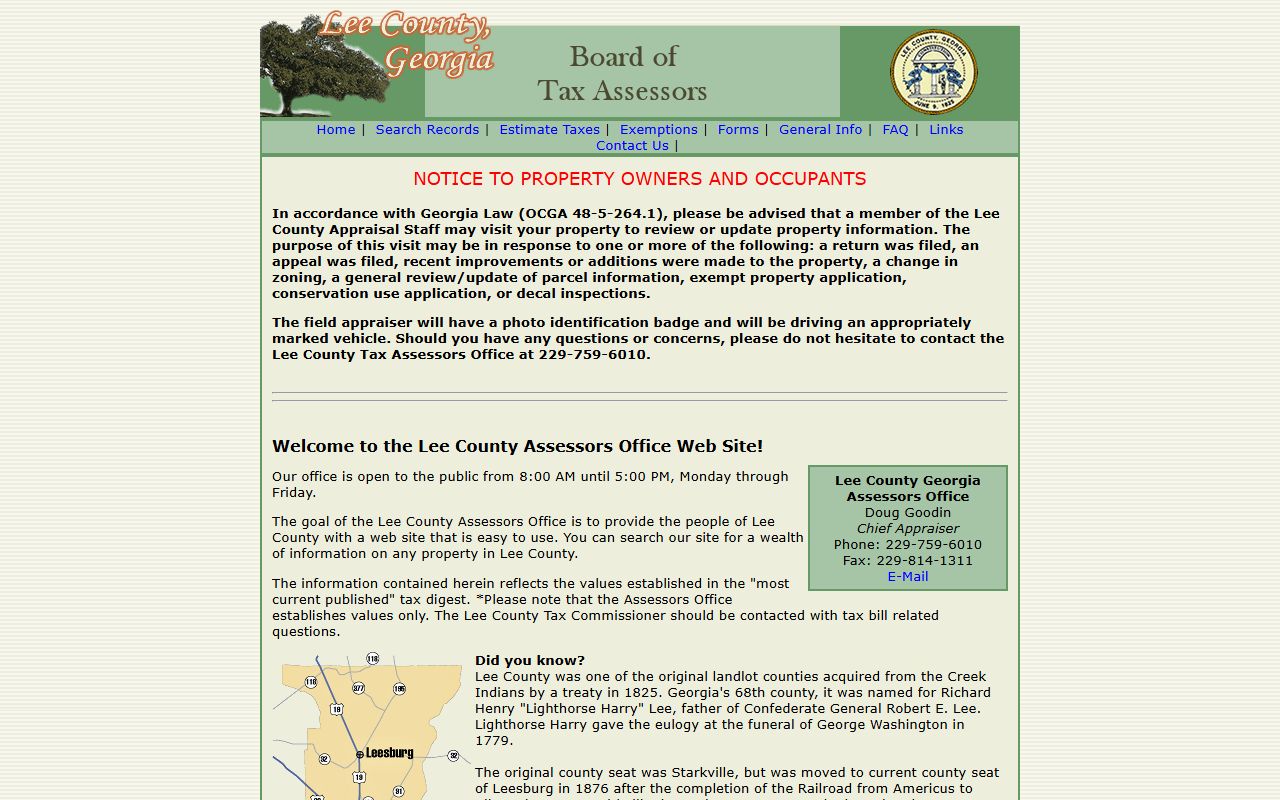
The QPublic system displays current year assessment values, property details, and sales history. Users can view aerial imagery and tax maps. The platform also shows exemption information and special assessments. This transparency helps property owners verify their records are accurate before tax bills arrive.
| Online Records | http://www.qpublic.net/ga/lee/ |
|---|---|
| System | QPublic.net |
| Search Options | Owner name, address, parcel ID, map location |
| Cost | Free public access |
The Tax Assessor office in Leesburg handles appeals and questions about valuations. Staff can explain how values were determined and what factors influenced changes. Visit the courthouse complex in Leesburg for in-person assistance with complex property issues.
How to Search Lee County Property Tax Records
Finding Lee County property tax records is straightforward with the online tools available. The QPublic.net system serves as the primary search portal for property assessments. Begin by visiting the Lee County page on QPublic. The search interface accepts multiple query types to help you locate specific properties.
To search by owner name, enter the last name first followed by the first name. The system will display all properties associated with that owner. Address searches work with partial street names if you are unsure of the complete address. Parcel ID searches provide the most direct results when you have the identification number from previous tax documents.
Search results display the property's assessed value, which consists of land value and improvement value. The total fair market value appears alongside any applicable exemptions. Review these figures carefully to ensure accuracy. Errors in property records can lead to incorrect tax bills.
The mapping feature on QPublic allows visual property identification. Navigate the interactive map to locate parcels by geography. This helps when researching neighboring properties or verifying boundary lines. Aerial imagery provides additional context about land use and improvements.
For historical research, the system maintains sales data for recent transactions. View the sales history section to see when a property last changed hands and the transaction amount. This information assists homeowners considering appeals and buyers researching market values.
Paying Property Taxes in Lee County
Property tax payments in Lee County are handled through the Tax Commissioner office. Tax bills are typically mailed in the fall with payment due early the following year. The exact dates vary, so monitor your mailbox for the official notice. Late payments accrue interest and penalties, so timely remittance is important.
Lee County offers multiple payment methods to accommodate different preferences. Online payment options provide convenience for those who prefer digital transactions. Credit cards, debit cards, and electronic checks are typically accepted through the payment portal. Service fees may apply for card payments.
- Online payments through the official county payment portal
- In-person payments at the Leesburg courthouse
- Mail payments with check or money order
- Drop box for after-hours convenience
In-person payments allow direct interaction with staff who can answer questions. The Leesburg office maintains regular business hours Monday through Friday. Bring your tax bill or parcel number to ensure proper credit. Cash, check, and card payments are accepted at the counter.
Mail payments must be postmarked by the due date to avoid late fees. Send payments to the Tax Commissioner address in Leesburg. Include your tax bill stub or write the parcel number on your check. Allow adequate mailing time, especially during holiday periods.
Lee County Homestead Exemptions
Homestead exemptions reduce the taxable value of primary residences, lowering property tax bills for qualified homeowners. Georgia provides a standard statewide exemption that applies to all owner-occupied homes. Lee County homeowners may also qualify for additional local exemptions depending on age, income, or disability status.
The basic homestead exemption removes a portion of your home's assessed value from taxation. To qualify, you must own and occupy the property as your primary residence as of January first of the tax year. Rental properties and vacation homes do not qualify for this exemption.
Senior citizens age sixty-five and older may qualify for additional exemptions. These often have income restrictions that vary by exemption type. Disabled veterans and surviving spouses may also receive special benefits. Contact the Lee County Tax Commissioner to learn which exemptions apply to your situation.
The application deadline for homestead exemptions is typically April first each year. You must apply once to establish the exemption on your property. After approval, the exemption renews automatically each year as long as you continue to qualify. File promptly to ensure savings appear on your next tax bill.
| Standard Exemption | $2,000 off assessed value for primary residence |
|---|---|
| Application Deadline | April 1 each year |
| Required Documents | Proof of ownership, Georgia driver's license, utility bill |
| Renewal | Automatic after initial approval |
Appealing Your Property Assessment in Lee County
Georgia law guarantees property owners the right to appeal their assessed values. If you believe your Lee County property assessment is incorrect, you can challenge it through the formal appeal process. Appeals must be filed within forty-five days of the assessment notice date. Missing this deadline forfeits your right to appeal for that tax year.
The appeal process begins with filing a written protest with the Board of Tax Assessors. State clearly why you believe the value is inaccurate. Common grounds for appeal include values exceeding fair market price, unequal assessment compared to similar properties, or errors in property description. Supporting documentation strengthens your case.
Evidence for your appeal might include recent sales of comparable properties, independent appraisals, or photographs showing property condition issues. The assessor's office reviews your submission and may propose a settlement. Many appeals resolve through negotiation before formal hearings.
If you cannot reach agreement with the assessor, your case proceeds to the Board of Equalization. This independent board of citizens hears appeals and renders decisions. Alternatively, you may choose arbitration or a hearing officer depending on the circumstances. Learn more about your rights at https://dor.georgia.gov/property-taxpayers-bill-rights.
The appeal process protects taxpayers from unfair assessments. Values should reflect actual market conditions. If your assessment seems out of line with neighborhood sales, consider filing an appeal. The system exists to ensure fair treatment for all Lee County property owners.
Related Areas in Lee County
Leesburg serves as the county seat and primary population center for Lee County. The city hosts government offices, shopping districts, and residential neighborhoods. Most property tax transactions occur at the courthouse in downtown Leesburg. Residents throughout the county travel here for assessment and payment services.
Smithville provides another population center in the northern part of the county. This smaller community offers a quieter rural lifestyle while maintaining access to county services. Property in Smithville falls under the same tax assessment rules as the rest of Lee County.
Unincorporated areas make up significant portions of Lee County. These rural and suburban zones rely on county government for all services. Property owners in unincorporated areas use the same QPublic system and Leesburg offices for tax matters. All Lee County residents benefit from the online record access regardless of their specific location.
Nearby Counties
Lee County shares borders with several other Georgia counties. If you own property near these boundaries, verify which county handles your tax assessment. Each Georgia county maintains separate tax records and offices.
Additional Resources
These websites provide additional information about Lee County property taxes:
Lee County QPublic.net - Online property records and assessments
Georgia DOR County Tax Facts - Statewide property tax information
Georgia Taxpayer Bill of Rights - Your rights as a property owner